Ever found yourself wondering how to handle things when someone is clearly trying to take advantage of you or manipulate the situation? That’s exactly where Best Responses to Someone Playing You become important—because the way you respond can either keep you stuck in the drama or instantly put you back in control.
The problem is, it’s not always obvious at first. Someone might act friendly, confusing, or even innocent, while slowly pushing boundaries. And here’s the kicker: reacting emotionally in the moment can often make things worse instead of better.
Many people deal with this in relationships, friendships, and even workplace situations, where they need clever comebacks for manipulation, polite ways to set boundaries, or confident responses to disrespect without escalating conflict.
But don’t worry—there’s a smarter way to handle it.
In this guide, you’ll discover the Best Responses to Someone Playing You, including calm, confident, and strategic replies that help you set boundaries, protect your self-respect, and stay emotionally in control. You’ll also learn how to respond without overexplaining or giving away your power.
So if you’re ready to stop second-guessing yourself and start responding with clarity and confidence, you’re in the right place.
1. Calm Response to Emotional Manipulation
A young person once noticed their partner constantly twisting conversations to create guilt. Instead of arguing, they chose calm words and clarity. This helped them avoid emotional traps and regain control of the situation without escalating conflict.
Example: “I understand your point, but I don’t agree with being blamed like this.”
Best Use: When someone tries guilt-tripping or twisting facts.
Explanation: Keeps you grounded and avoids emotional escalation.
When Not to Use: When direct confrontation is necessary for clarity.
2. Witty Comeback for Being Played
Sometimes humor can be more powerful than anger. One individual used a witty reply when they realized they were being misled, instantly changing the energy of the conversation and exposing the manipulation without hostility.
Example: “Wow, that story changed faster than a Netflix plot.”
Best Use: Light manipulation or casual dishonesty.
Explanation: Uses humor to highlight inconsistency.
When Not to Use: Serious emotional or abusive situations.
3. Assertive Boundary Setting Response
A person once felt drained by constant emotional games, so they finally set a clear boundary. This shifted the dynamic immediately and forced the other person to respect limits.
Example: “I’m not okay with being treated this way. Please stop.”
Best Use: Repeated disrespect or manipulation.
Explanation: Establishes clear emotional limits.
When Not to Use: When you are still gathering facts.
4. Emotional Detachment Reply
A professional learned to detach emotionally when a colleague tried manipulation. By staying neutral, they avoided stress and maintained control over decisions.
Example: “I hear you, but I’m not emotionally invested in this discussion.”
Best Use: Toxic conversations or workplace drama.
Explanation: Reduces emotional impact.
When Not to Use: Close relationships needing emotional honesty.
5. Direct Confrontation Response
A friend group situation once became toxic, and one member directly addressed the issue. This honest approach cleared misunderstandings and revealed hidden intentions.
Example: “Are you being honest with me, or is there something else going on?”
Best Use: When clarity is needed immediately.
Explanation: Forces transparency.
When Not to Use: When safety or emotions are fragile.
6. Self-Respect Affirmation Reply
Someone recovering from emotional manipulation learned to prioritize self-worth over approval. This response helped them step back from toxic patterns.
Example: “I respect myself too much to continue this behavior.”
Best Use: Repeated disrespect or manipulation cycles.
Explanation: Reinforces dignity.
When Not to Use: Early misunderstandings.
7. Silent Exit Strategy Response
Instead of arguing, a person simply chose to walk away from toxic behavior. Silence became their strongest boundary and preserved their peace.
Example: No response, just leaving the conversation.
Best Use: Persistent manipulation or disrespect.
Explanation: Silence removes attention.
When Not to Use: When closure is required.
8. Logical Breakdown Reply
A student dealing with emotional confusion used logic to analyze contradictions in someone’s statements, making manipulation harder to continue.
Example: “Earlier you said this, now you’re saying that—can you clarify?”
Best Use: Conflicting stories or excuses.
Explanation: Exposes inconsistency.
When Not to Use: Emotional arguments.
9. Sarcastic Reality Check Response
A witty individual used sarcasm to highlight obvious emotional games, making the manipulator rethink their approach.
Example: “Oh yes, because that totally makes sense… not.”
Best Use: Mild manipulation.
Explanation: Highlights absurdity.
When Not to Use: Serious emotional abuse.
10. Boundary Reinforcement Message
A person in a relationship learned to repeat boundaries until they were respected. This created emotional discipline in communication.
Example: “I already explained my boundary, I expect it to be respected.”
Best Use: Repeated violations.
Explanation: Strengthens consistency.
When Not to Use: First-time misunderstandings.
11. Cold Truth Response
Sometimes honesty needs to be direct and uncomfortable. A person finally spoke truthfully after realizing they were being played.
Example: “It feels like you’re not being genuine with me.”
Best Use: Emotional clarity situations.
Explanation: Forces honesty.
When Not to Use: Highly sensitive emotional moments.
12. Indifference Reply Strategy
One of the strongest responses is showing you simply don’t care about manipulation. This reduces the manipulator’s control instantly.
Example: “Okay.”
Best Use: Attention-seeking behavior.
Explanation: Removes emotional reward.
When Not to Use: Important relationship discussions.
13. Accountability Question Response
A friend once turned manipulation into reflection by asking accountability-based questions that exposed intentions.
Example: “What outcome are you trying to achieve by saying this?”
Best Use: Psychological manipulation.
Explanation: Forces self-reflection.
When Not to Use: Casual chats.
14. Calm Exit Statement
Instead of arguing, a calm exit preserves dignity and mental peace.
Example: “I don’t think this conversation is productive anymore.”
Best Use: Toxic or repetitive arguments.
Explanation: Ends escalation.
When Not to Use: Important discussions.
15. Emotional Clarity Response
A person once realized confusion was being used as control, so they demanded clarity.
Example: “Please be clear about your intentions.”
Best Use: Mixed signals.
Explanation: Removes ambiguity.
When Not to Use: Already clear situations.
16. No-Engagement Reply
Choosing not to engage prevents emotional exhaustion and manipulation cycles.
Example: “I’m not discussing this further.”
Best Use: Repeated toxic patterns.
Explanation: Cuts energy supply.
When Not to Use: Necessary problem-solving.
17. Mirror Response Technique
Mirroring exposes behavior by reflecting it back subtly.
Example: “So you think it’s okay to treat people like that?”
Best Use: Manipulative behavior.
Explanation: Creates awareness.
When Not to Use: Emotional vulnerability moments.
18. Respect Demand Response
A strong boundary requires respect, not negotiation.
Example: “I expect to be spoken to with respect.”
Best Use: Disrespectful tone.
Explanation: Sets standards.
When Not to Use: Friendly jokes.
19. Emotional Distance Clarification
This response helps reduce emotional confusion in relationships.
Example: “I feel like we’re not on the same emotional page.”
Best Use: Relationship imbalance.
Explanation: Identifies disconnect.
When Not to Use: Stable relationships.
20. Final Warning Response
When behavior continues, a final warning sets consequences.
Example: “If this continues, I will step away.”
Best Use: Repeated manipulation.
Explanation: Adds consequences.
When Not to Use: First conflicts.
21. Peace Priority Reply
A person chooses peace over winning arguments.
Example: “My peace matters more than this conversation.”
Best Use: Emotional chaos.
Explanation: Prioritizes mental health.
When Not to Use: Critical discussions.
22. Emotional Intelligence Response
A thoughtful response that shows awareness without reacting emotionally.
Example: “I can see what’s happening here.”
Best Use: Subtle manipulation.
Explanation: Shows awareness.
When Not to Use: Direct confrontation needed.
23. Complete Cut-Off Response
Sometimes the best response is total separation from toxicity.
Example: No reply + block or distance.
Best Use: Severe manipulation or abuse.
Explanation: Ends access completely.
When Not to Use: Salvageable relationships.
24. Honest Self-Reflection Response
A mature response that shifts focus inward instead of conflict.
Example: “I need to think about how this affects me.”
Best Use: Emotional confusion.
Explanation: Encourages clarity.
When Not to Use: Immediate decisions required.
25. Final Closure Statement
A strong ending that closes emotional loops.
Example: “This situation doesn’t work for me anymore.”
Best Use: Ending toxic cycles.
Explanation: Provides closure.
When Not to Use: Repairable issues.
26. Emotion-Free Response Strategy
A person once realized that reacting emotionally only gave manipulators more control. So they started responding without emotional charge, which completely shifted the power balance in conversations.
Example: “I understand what you’re saying.”
Best Use: Emotional manipulation attempts.
Explanation: Removes emotional fuel.
When Not to Use: Deep emotional relationships needing warmth.
27. Strategic Pause Reply
Instead of reacting instantly, a person paused before replying to avoid being trapped in emotional pressure. This gave them time to think clearly.
Example: “I’ll get back to you on that.”
Best Use: High-pressure conversations.
Explanation: Prevents impulsive replies.
When Not to Use: Urgent decisions.
28. Clarification Demand Response
A confused individual stopped guessing intentions and started demanding clarity, which exposed manipulation patterns.
Example: “Can you explain exactly what you mean?”
Best Use: Mixed signals or vague behavior.
Explanation: Forces precision.
When Not to Use: Already clear communication.
29. Emotional Boundary Reminder
A person repeatedly reminded others of emotional limits until respect was restored in the relationship.
Example: “I’ve already said I’m not okay with this.”
Best Use: Repeated disrespect.
Explanation: Reinforces consistency.
When Not to Use: First-time misunderstandings.
30. Reality-Focused Response
Instead of reacting to emotions, a person focused only on facts to avoid manipulation.
Example: “Let’s stick to what actually happened.”
Best Use: Distorted narratives.
Explanation: Grounds conversation in truth.
When Not to Use: Emotional healing talks.
31. Emotional Withdrawal Reply
A person slowly reduced emotional availability when they noticed manipulation patterns.
Example: “I don’t feel comfortable continuing this.”
Best Use: Toxic emotional cycles.
Explanation: Creates distance.
When Not to Use: Healthy communication.
32. Accountability Challenge Response
A direct challenge helped expose hidden intentions in manipulative behavior.
Example: “Why are you trying to make me feel guilty?”
Best Use: Guilt-tripping.
Explanation: Brings awareness.
When Not to Use: Sensitive emotional moments.
33. Self-Validation Response
A person learned to validate their own feelings instead of seeking approval from manipulators.
Example: “I know how I feel about this.”
Best Use: Gaslighting situations.
Explanation: Builds confidence.
When Not to Use: Collaborative discussions.
34. Non-Reactive Silence
Instead of replying, silence was used strategically to stop emotional escalation.
Example: No response at all.
Best Use: Provocation attempts.
Explanation: Denies attention.
When Not to Use: Important clarification needed.
35. Emotional Reset Statement
A person reset the tone of conversation by stepping away from emotional chaos.
Example: “Let’s continue this when things are calmer.”
Best Use: Heated arguments.
Explanation: Restores balance.
When Not to Use: Urgent matters.
36. Firm No Response
Learning to say “no” without explanation helped someone escape manipulation cycles.
Example: “No, I’m not comfortable with that.”
Best Use: Pressure situations.
Explanation: Sets firm boundary.
When Not to Use: Negotiation-based talks.
37. Observation-Based Reply
A calm observation exposes patterns without direct accusation.
Example: “I notice this keeps happening.”
Best Use: Repeated behavior issues.
Explanation: Reduces defensiveness.
When Not to Use: First-time issues.
38. Emotional Independence Statement
A person declared emotional independence to break manipulation cycles.
Example: “My decisions are not influenced by pressure.”
Best Use: Control attempts.
Explanation: Establishes autonomy.
When Not to Use: Cooperative decisions.
39. Calm Truth Exposure
Truth spoken calmly often has more impact than emotional arguments.
Example: “This doesn’t feel honest to me.”
Best Use: Dishonesty detection.
Explanation: Encourages transparency.
When Not to Use: Assumptions without proof.
40. Time-Out Boundary Response
Taking time away prevents emotional damage during manipulation.
Example: “I need some time before responding.”
Best Use: Emotional overload.
Explanation: Prevents escalation.
When Not to Use: Time-sensitive issues.
41. Detached Agreement Reply
A neutral agreement removes emotional engagement without escalating conflict.
Example: “If that’s how you see it.”
Best Use: Provocation attempts.
Explanation: Ends argument loop.
When Not to Use: Important clarification.
42. Emotional Reality Check
A person calls out emotional imbalance clearly and calmly.
Example: “This situation feels one-sided.”
Best Use: Unbalanced relationships.
Explanation: Highlights fairness issues.
When Not to Use: Early misunderstandings.
43. Respectful Distance Statement
Distance is sometimes necessary to protect emotional health.
Example: “I think we need space.”
Best Use: Toxic cycles.
Explanation: Creates healing space.
When Not to Use: Healthy disagreements.
44. Pattern Recognition Response
A mature response that identifies repeated manipulation patterns.
Example: “This feels like something we’ve discussed before.”
Best Use: Repeated behavior.
Explanation: Encourages accountability.
When Not to Use: First occurrences.
45. Emotional Clarity Exit
Leaving confusion behind helps restore peace.
Example: “I don’t want confusion in my life.”
Best Use: Mixed signals.
Explanation: Protects mental clarity.
When Not to Use: Stable communication.
46. Final Emotional Detachment
Complete emotional disengagement ends manipulation cycles.
Example: “I’m done engaging in this dynamic.”
Best Use: Persistent toxicity.
Explanation: Ends emotional loop.
When Not to Use: Fixable issues.
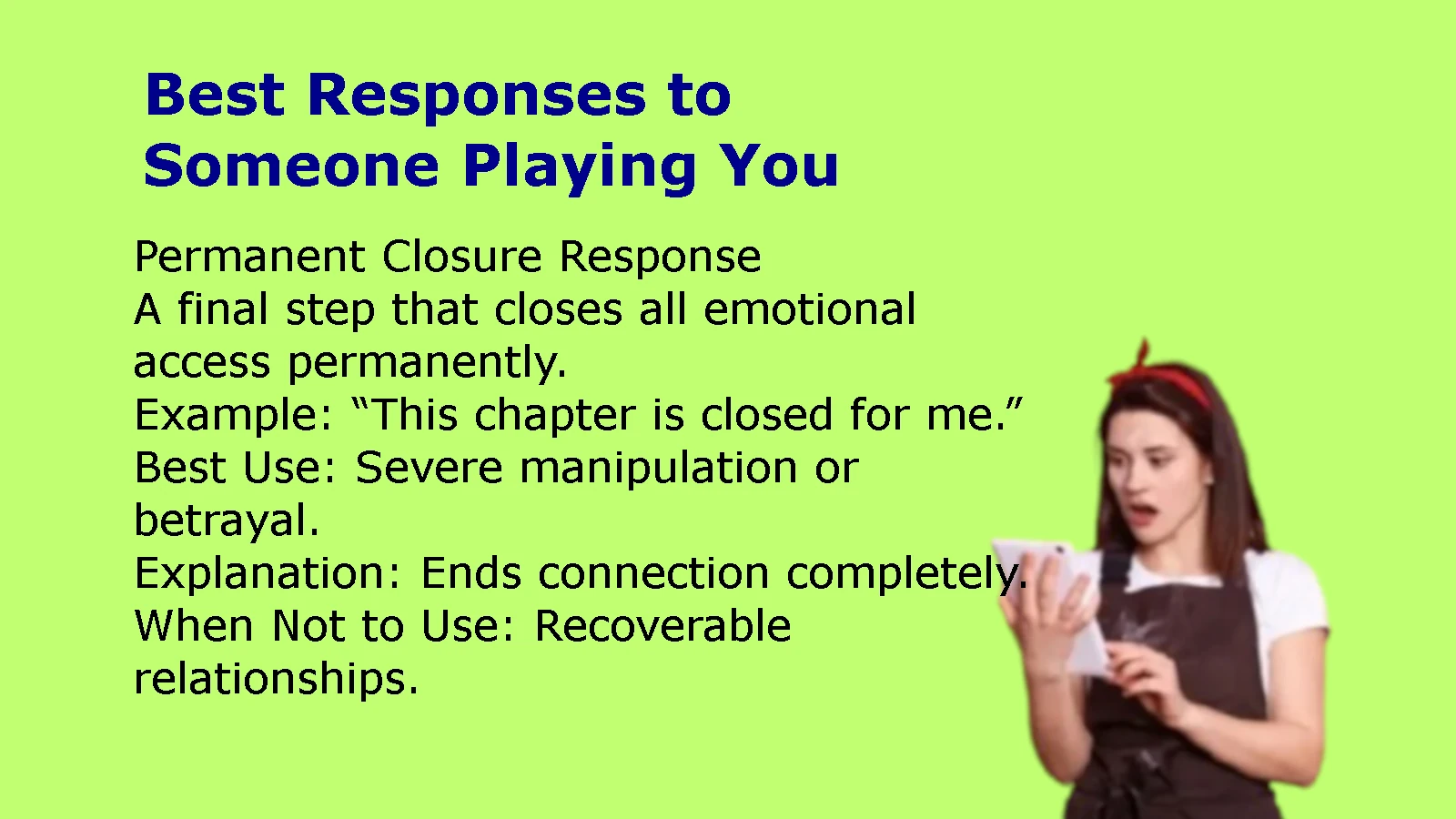
47. Permanent Closure Response
A final step that closes all emotional access permanently.
Example: “This chapter is closed for me.”
Best Use: Severe manipulation or betrayal.
Explanation: Ends connection completely.
When Not to Use: Recoverable relationships.
Final Conclusion
Mastering these 47 best responses to someone playing you gives you emotional strength, mental clarity, and the ability to protect your boundaries. The key is not to “win” conversations—but to protect your peace, dignity, and emotional wellbeing.
Whether you choose silence, humor, assertiveness, or distance, the right response always brings you closer to self-respect and emotional freedom.