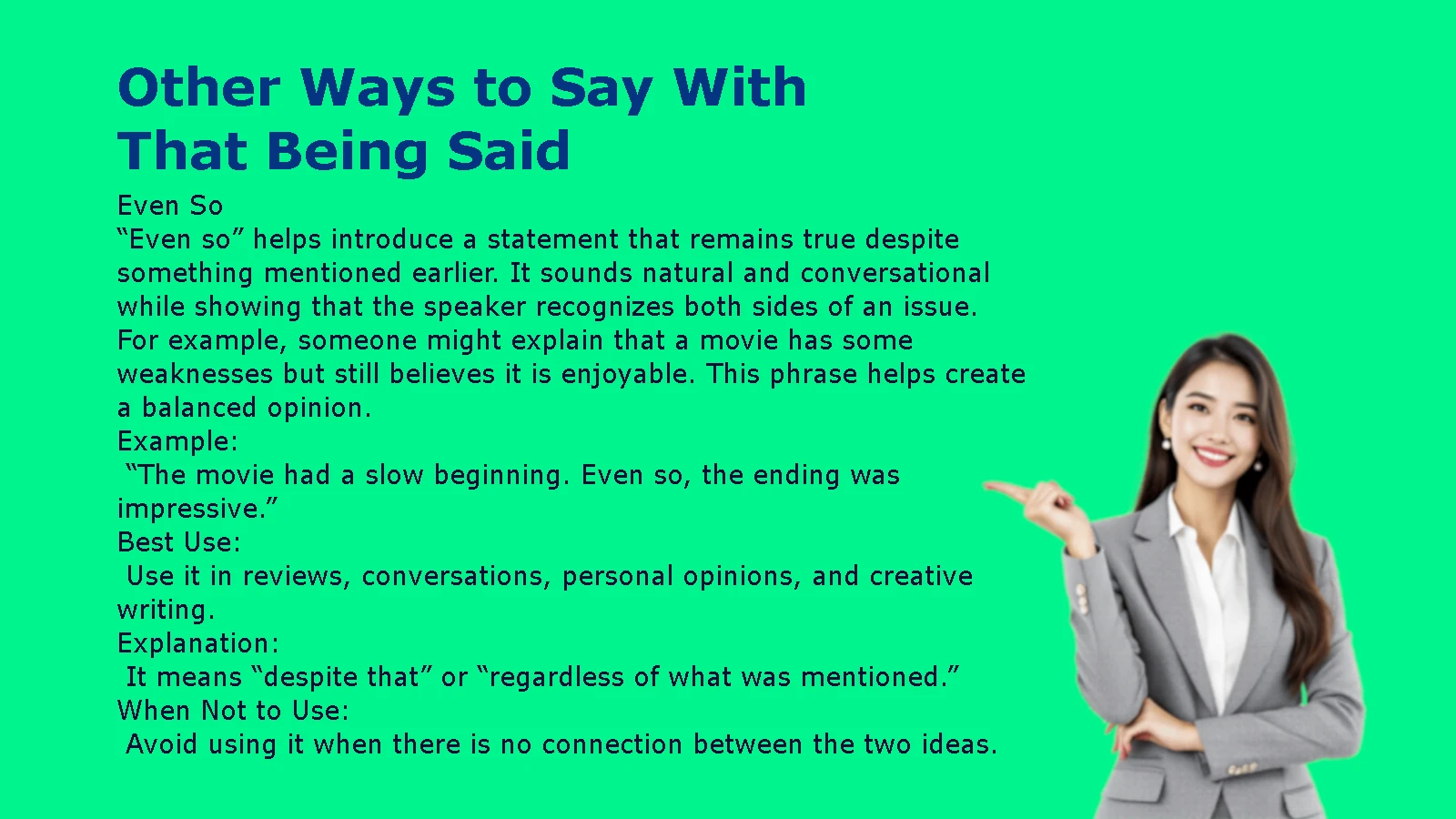
With that being said is a transition phrase used to introduce a related point, contrast, or conclusion. It helps connect ideas smoothly while acknowledging what was just said before presenting a new thought.
Examples:
I understand your concerns. With that being said, we need to make a decision today.
With that being said, let’s begin the meeting.
The project is challenging. With that being said, I believe we can finish it on time.
The challenge is that not every situation calls for the same transition. In professional emails, academic writing, presentations, or casual conversations, a different expression may sound smoother and more natural. But here’s the good news: a simple alternative can improve the flow of your message and make your communication more engaging.
In this guide, you’ll discover Other Ways to Say With That Being Said, including with that being said synonyms, alternative transition phrases, formal alternatives, and casual expressions for different contexts. You’ll also see practical examples showing how to replace “with that being said” naturally in sentences, emails, and everyday conversations.
By the end, you’ll have a collection of versatile phrases that help you transition between ideas with greater clarity, confidence, and style.
1. However
Sometimes a conversation needs a gentle change in direction. “However” is one of the most common replacements for “with that being said” because it introduces a contrast while keeping the discussion balanced. It helps readers understand that a new idea may differ from the previous statement but is still connected.
For example, a writer may explain the benefits of a product and then use “however” to mention a limitation. This transition creates a natural flow between positive and negative points.
Example:
“The new software has many useful features. However, it may require some time for beginners to learn.”
Best Use:
Use “however” in formal writing, academic papers, business reports, and professional communication.
Explanation:
It shows contrast and helps introduce a different perspective without sounding too informal.
When Not to Use:
Avoid using it when you are not presenting an opposite or contrasting idea.
2. That Said
“That said” is a shorter and more modern alternative to “with that being said.” It works well when you want to acknowledge a previous point before adding another thought. This phrase is popular in professional writing, blogs, and conversations because it sounds natural without being overly formal.
Imagine someone explaining the challenges of learning a new skill but then mentioning the rewards. “That said” creates a bridge between the two ideas.
Example:
“The course requires dedication and practice. That said, many students find it extremely rewarding.”
Best Use:
Use it in articles, emails, discussions, and opinion-based writing.
Explanation:
It shows that the next statement does not completely reject the previous idea but adds another viewpoint.
When Not to Use:
Avoid using it repeatedly in the same piece of content because it can become repetitive.
3. Nevertheless
When you want to highlight that something remains true despite a previous point, “nevertheless” is an excellent choice. It adds a sense of determination and balance to your writing. This phrase is often used when acknowledging a challenge but emphasizing the importance of continuing.
For instance, a person may describe difficulties in starting a business but explain that success is still possible. “Nevertheless” creates a strong transition between obstacles and possibilities.
Example:
“The project faced several unexpected problems. Nevertheless, the team completed it successfully.”
Best Use:
Use it in formal writing, reports, essays, and professional discussions.
Explanation:
It communicates “despite this situation, the following point remains important.”
When Not to Use:
Avoid using it in very casual conversations because it may sound slightly formal.
4. On the Other Hand
“On the other hand” is a helpful phrase when presenting another side of an argument or comparing different viewpoints. It allows writers and speakers to show fairness by considering multiple perspectives. This phrase is especially useful when discussing advantages and disadvantages.
A person might explain why a decision seems beneficial and then introduce possible concerns. This makes the discussion more complete and thoughtful.
Example:
“Working from home saves commuting time. On the other hand, some people miss daily interaction with coworkers.”
Best Use:
Use it in comparisons, debates, reviews, and analytical writing.
Explanation:
It introduces an alternative perspective or opposing idea.
When Not to Use:
Do not use it if you are simply adding extra information without contrast.
5. Having Said That
“Having said that” is a direct alternative to “with that being said.” It allows you to recognize a previous statement while introducing a related but slightly different idea. This phrase sounds thoughtful and conversational, making it useful in many situations.
For example, someone may discuss the disadvantages of a product but then mention why customers still enjoy it. The phrase helps maintain balance.
Example:
“The restaurant can get crowded during weekends. Having said that, the food quality is excellent.”
Best Use:
Use it in conversations, reviews, blogs, and informal professional writing.
Explanation:
It shows that you are considering another angle before continuing.
When Not to Use:
Avoid using it in highly technical writing where shorter transitions may be clearer.
6. Still
Sometimes a simple word can create a powerful transition. “Still” is a casual and effective replacement when you want to show that something remains true despite previous information. It keeps your writing friendly and easy to understand.
For example, someone may mention that a task is difficult but explain that they want to continue. “Still” creates a smooth connection between these ideas.
Example:
“The exam was challenging. Still, many students performed well.”
Best Use:
Use it in everyday conversations, blogs, emails, and personal writing.
Explanation:
It expresses continuation despite a situation or problem.
When Not to Use:
Avoid using it in formal academic writing when a more precise transition is needed.
7. Even So
“Even so” helps introduce a statement that remains true despite something mentioned earlier. It sounds natural and conversational while showing that the speaker recognizes both sides of an issue.
For example, someone might explain that a movie has some weaknesses but still believes it is enjoyable. This phrase helps create a balanced opinion.
Example:
“The movie had a slow beginning. Even so, the ending was impressive.”
Best Use:
Use it in reviews, conversations, personal opinions, and creative writing.
Explanation:
It means “despite that” or “regardless of what was mentioned.”
When Not to Use:
Avoid using it when there is no connection between the two ideas.
8. Despite That
“Despite that” is a useful phrase when you want to acknowledge a problem or limitation while showing that the outcome remains positive. It creates a clear relationship between a challenge and a result.
For example, a student may struggle with a difficult subject but continue improving through practice. The phrase highlights perseverance and progress.
Example:
“The instructions were confusing. Despite that, we managed to complete the task.”
Best Use:
Use it in personal writing, explanations, and storytelling.
Explanation:
It emphasizes that something happened even though there was a difficulty.
When Not to Use:
Avoid it when the previous statement is not a challenge or negative situation.
9. Still, It Is Worth Mentioning
Sometimes a writer needs to add an important point without completely changing the previous idea. “Still, it is worth mentioning” works as a thoughtful transition that highlights additional information. It is especially useful when you want readers to pay attention to a detail that may influence their understanding.
For example, a product may have many advantages, but a small limitation should also be considered. This phrase helps introduce that extra information in a balanced way.
Example:
“The program offers excellent training opportunities. Still, it is worth mentioning that beginners may need extra guidance.”
Best Use:
Use it in articles, reviews, reports, and informative content.
Explanation:
It signals that the upcoming information is important and deserves attention.
When Not to Use:
Avoid using it in short messages where a simpler transition works better.
10. At the Same Time
“At the same time” is a flexible alternative that introduces another perspective while keeping both ideas connected. It helps writers show that two thoughts can exist together without completely opposing each other.
This phrase is often used when discussing advantages and disadvantages, personal opinions, or complicated situations. It creates a sense of balance and encourages readers to consider multiple factors.
Example:
“The job offers a good salary. At the same time, it requires long working hours.”
Best Use:
Use it in business writing, discussions, presentations, and everyday communication.
Explanation:
It shows that another point should be considered alongside the first idea.
When Not to Use:
Avoid it when the second idea is not connected to the first one.
11. Although That May Be True
“Although that may be true” is a respectful way to acknowledge someone’s statement before sharing another opinion. It is commonly used in discussions because it recognizes the previous argument while allowing room for another perspective.
This phrase makes communication feel more polite and thoughtful. It prevents disagreements from sounding too direct or negative.
Example:
“Although that may be true, we should also consider the long term effects.”
Best Use:
Use it in debates, discussions, essays, and professional conversations.
Explanation:
It shows agreement with part of an idea while introducing another point.
When Not to Use:
Avoid using it when you completely disagree and need a stronger transition.
12. In Contrast
When two ideas are different, “in contrast” provides a clear way to highlight the difference. It is commonly used in analytical writing because it helps readers compare information easily.
Writers often use this phrase when discussing two products, opinions, methods, or results. It creates a logical connection between different viewpoints.
Example:
“The first method focuses on speed. In contrast, the second method focuses on accuracy.”
Best Use:
Use it in research papers, comparisons, reviews, and professional documents.
Explanation:
It introduces a direct difference between two ideas.
When Not to Use:
Avoid using it when the next statement is simply additional information.
13. Regardless
“Regardless” is a concise transition that shows an idea remains valid despite previous information. It communicates confidence and determination, making it useful in motivational writing and decision making.
For example, someone may face difficulties but continue moving forward. This word emphasizes that the final decision or result does not change.
Example:
“The process may take longer than expected. Regardless, we will complete the project.”
Best Use:
Use it in professional communication, motivational content, and personal statements.
Explanation:
It means something remains true despite circumstances.
When Not to Use:
Avoid it when you need to explain a detailed contrast.
14. Even Though
“Even though” introduces a contrast between two ideas and is commonly used in everyday language. It sounds natural and conversational while still providing a clear connection between thoughts.
This phrase is helpful when explaining situations where one fact does not prevent another outcome from happening.
Example:
“Even though the weather was difficult, the event was successful.”
Best Use:
Use it in conversations, blogs, stories, and casual writing.
Explanation:
It highlights a surprising result despite a condition.
When Not to Use:
Avoid it in very formal writing where stronger academic transitions are preferred.
15. Still, It Is Important to Note
This phrase works well when adding valuable information after explaining a main point. “Still, it is important to note” signals that readers should pay attention to the upcoming detail.
It is often used by writers who want to provide a complete and balanced explanation rather than only presenting one side.
Example:
“The software is easy to use. Still, it is important to note that advanced features require training.”
Best Use:
Use it in guides, educational articles, and professional content.
Explanation:
It introduces a meaningful detail that improves understanding.
When Not to Use:
Avoid using it repeatedly because it can make writing sound too structured.
16. With This in Mind
“With this in mind” is a useful transition when you want readers to consider previous information before moving forward. It creates a connection between an earlier point and the next conclusion or recommendation.
This phrase works especially well in advice articles, planning documents, and explanations where context matters.
Example:
“The market is becoming more competitive. With this in mind, businesses should improve customer service.”
Best Use:
Use it in recommendations, strategies, reports, and educational content.
Explanation:
It means “considering what was just discussed.”
When Not to Use:
Avoid it when the next sentence does not depend on the previous idea.
17. On That Note
“On that note” creates a smooth transition when moving from one related idea to another. It sounds friendly and natural, making it popular in conversations, podcasts, emails, and online content.
It helps maintain a logical flow without sounding too formal or repetitive.
Example:
“The team achieved excellent results this year. On that note, we should celebrate their efforts.”
Best Use:
Use it in casual professional communication, speeches, and conversations.
Explanation:
It connects the next thought with the previous discussion.
When Not to Use:
Avoid it in formal academic writing where more precise transitions are better.
18. To Put It Another Way
“To put it another way” is useful when you want to explain an idea differently or provide another perspective. It does not always show contrast but helps clarify a point.
Writers often use this phrase when simplifying information for readers or adding another explanation.
Example:
“The strategy requires patience. To put it another way, success will not happen overnight.”
Best Use:
Use it in educational content, tutorials, and explanations.
Explanation:
It introduces a clearer or alternative explanation.
When Not to Use:
Avoid it when you are not rephrasing or explaining something.
19. In Any Case
“In any case” is a practical alternative to “with that being said” when you want to move a discussion forward after considering different points. It shows that regardless of previous details, the next statement remains important. This phrase creates a smooth transition and helps readers focus on the main conclusion.
For example, after discussing different possibilities, a writer may use this phrase to introduce the final decision or recommendation. It keeps the message organized and clear.
Example:
“The plan may require extra resources. In any case, we should begin preparing as soon as possible.”
Best Use:
Use it in professional emails, discussions, reports, and everyday conversations.
Explanation:
It means “regardless of the situation” or “considering everything mentioned.”
When Not to Use:
Avoid it when you need to introduce a strong contrast between two ideas.
20. All Things Considered
“All things considered” is a thoughtful phrase that shows you have looked at different factors before reaching a conclusion. It gives your writing a balanced and mature tone.
This expression is often used when discussing decisions, opinions, or evaluations. It helps readers understand that the final point comes after careful thinking.
Example:
“The product has some minor issues. All things considered, it is still a valuable investment.”
Best Use:
Use it in reviews, analysis, recommendations, and opinion writing.
Explanation:
It introduces a conclusion after considering all available information.
When Not to Use:
Avoid using it for simple statements that do not require evaluation.
21. Nevertheless, It Should Be Noted
“Nevertheless, it should be noted” is a formal transition that allows writers to introduce an important exception or additional point. It is commonly found in professional and academic writing where accuracy and balance are important.
This phrase helps create a careful explanation by recognizing one idea while adding another important detail.
Example:
“The research shows positive results. Nevertheless, it should be noted that more studies are required.”
Best Use:
Use it in academic papers, reports, research articles, and formal documents.
Explanation:
It highlights information that should not be ignored.
When Not to Use:
Avoid it in casual conversations because it may sound too formal.
22. Even With That
“Even with that” is a simple conversational alternative that acknowledges a previous point before continuing with another thought. It works well when discussing challenges, limitations, or unexpected results.
This phrase makes conversations feel natural because it shows awareness of what was already mentioned.
Example:
“The project had a few delays. Even with that, the team delivered excellent results.”
Best Use:
Use it in casual discussions, personal writing, and informal communication.
Explanation:
It means something remains true despite the previous situation.
When Not to Use:
Avoid it in formal reports where a more precise phrase is better.
23. Despite This
“Despite this” is a clear and effective transition that introduces a result that happens even after a difficulty or challenge. It helps readers understand the relationship between a problem and an outcome.
Writers often use this phrase when explaining situations where obstacles exist but progress continues.
Example:
“The company faced financial challenges. Despite this, it continued to grow.”
Best Use:
Use it in news writing, reports, essays, and professional content.
Explanation:
It highlights that the next statement happens regardless of the previous issue.
When Not to Use:
Avoid using it if the previous sentence does not describe a problem or limitation.
24. That Being the Case
“That being the case” is a formal alternative that means “considering that information.” It is useful when you want to make a logical conclusion based on something already mentioned.
This phrase works well in structured writing because it clearly connects a situation with a response or decision.
Example:
“The deadline cannot be extended. That being the case, we need to adjust our schedule.”
Best Use:
Use it in business communication, legal writing, and formal discussions.
Explanation:
It connects a fact with the next logical action.
When Not to Use:
Avoid it in friendly conversations because it may sound too official.
25. Moving Forward
“Moving forward” is a popular phrase used when transitioning from previous information toward future actions. It helps shift attention from discussion to solutions.
Many professionals use this phrase when explaining plans, improvements, or next steps. It creates a positive and action focused tone.
Example:
“We identified several issues during the project. Moving forward, we will create a better process.”
Best Use:
Use it in business meetings, planning documents, and professional emails.
Explanation:
It directs attention toward future decisions or improvements.
When Not to Use:
Avoid it when you are only explaining past events.
26. Looking at It Another Way
“Looking at it another way” introduces a different viewpoint or interpretation. It encourages readers to think about an idea from a fresh perspective.
This phrase is helpful when explaining complex topics because it makes information easier to understand.
Example:
“The process seems expensive at first. Looking at it another way, it can save money over time.”
Best Use:
Use it in educational content, discussions, and creative writing.
Explanation:
It introduces another perspective without directly disagreeing.
When Not to Use:
Avoid it when the next point is unrelated.
27. In Light of This
“In light of this” is a professional phrase used when introducing a conclusion, decision, or recommendation based on previous information. It creates a strong connection between evidence and action.
This phrase is common in reports, business writing, and analytical content.
Example:
“Customer feedback shows a need for improvement. In light of this, the company will update its services.”
Best Use:
Use it in formal writing, research, reports, and presentations.
Explanation:
It means “because of this information.”
When Not to Use:
Avoid it in casual conversations where simpler phrases sound more natural.
28. Taking That Into Account
“Taking that into account” shows that you are considering previous information before making a statement. It creates a thoughtful and reasonable tone.
This phrase works well when explaining decisions that require careful consideration.
Example:
“The project has limited resources. Taking that into account, we created a simpler plan.”
Best Use:
Use it in planning, professional communication, and recommendations.
Explanation:
It shows that a decision is based on earlier information.
When Not to Use:
Avoid it when no previous factor affects the next statement.
29. With This Consideration
“With this consideration” is a formal phrase that introduces a point after evaluating specific information. It works well in structured writing where logical connections are important.
Although less common in everyday speech, it can be useful in professional documents.
Example:
“The audience prefers simple designs. With this consideration, the team created a cleaner layout.”
Best Use:
Use it in reports, proposals, and formal explanations.
Explanation:
It emphasizes careful thinking before reaching a conclusion.
When Not to Use:
Avoid it in casual writing because it may sound unnatural.
30. To Continue This Thought
“To continue this thought” is a smooth transition when you want to expand on an idea rather than completely change direction. It helps maintain flow in longer discussions and articles.
Writers often use this expression when developing arguments or explaining connected points.
Example:
“Technology has changed education significantly. To continue this thought, online learning will likely become even more common.”
Best Use:
Use it in articles, essays, speeches, and discussions.
Explanation:
It connects the next idea directly with the previous one.
When Not to Use:
Avoid it when you are introducing a completely unrelated topic.
31. Considering That
“Considering that” introduces a statement based on a specific fact or situation. It helps explain why a conclusion makes sense.
This phrase is useful when giving opinions, recommendations, or explanations because it shows reasoning.
Example:
“Considering that the company is new, its growth has been impressive.”
Best Use:
Use it in reviews, explanations, and analytical writing.
Explanation:
It means “because of this fact.”
When Not to Use:
Avoid it when no supporting reason is being provided.
32. Given That
“Given that” is a useful alternative when you want to introduce information that supports your next point. It shows that the following statement is based on a known fact, condition, or situation. This phrase makes writing sound logical and well structured, especially when explaining decisions or opinions.
For example, a manager may explain a decision by referring to current circumstances. “Given that” helps readers understand the reason behind an action.
Example:
“Given that the demand has increased, the company will expand its production.”
Best Use:
Use it in business writing, reports, professional communication, and analytical articles.
Explanation:
It connects a fact with a conclusion or decision.
When Not to Use:
Avoid it when you are not providing a reason or background information.
33. Keeping That in Mind
“Keeping that in mind” is a natural and reader friendly alternative that reminds people to consider previous information before moving forward. It creates a smooth connection between ideas and is commonly used in advice, recommendations, and explanations.
This phrase helps writers show that they are not ignoring earlier points but using them to guide the next thought.
Example:
“The audience prefers simple explanations. Keeping that in mind, we created an easy to follow guide.”
Best Use:
Use it in blogs, tutorials, emails, presentations, and educational content.
Explanation:
It means “remembering this information while making a decision.”
When Not to Use:
Avoid using it when the next point has no relationship with the previous statement.
34. From That Perspective
“From that perspective” introduces a different way of looking at a situation. It helps writers discuss ideas from another angle without directly rejecting the original point.
This phrase is especially useful in discussions where multiple opinions need to be considered. It encourages deeper thinking and balanced communication.
Example:
“The decision may seem expensive at first. From that perspective, it can be viewed as a long term investment.”
Best Use:
Use it in opinion articles, discussions, analysis, and presentations.
Explanation:
It introduces another viewpoint or interpretation.
When Not to Use:
Avoid it when you are simply adding extra information rather than changing the viewpoint.
35. In Conclusion
“In conclusion” is a familiar transition used to summarize ideas and present a final thought. While it is not always a direct replacement for “with that being said,” it works well when wrapping up a discussion after presenting different points.
Writers often use it to create a clear ending and help readers understand the main message.
Example:
“The strategy has several benefits and some challenges. In conclusion, it remains a useful approach for many businesses.”
Best Use:
Use it in essays, reports, presentations, and formal writing.
Explanation:
It signals that you are summarizing or finishing your discussion.
When Not to Use:
Avoid it when you are introducing a new idea rather than ending a topic.
36. The Same Goes For
“The same goes for” is a conversational alternative that connects a previous idea to another similar situation. It helps explain that the same principle or observation applies elsewhere.
This phrase is useful when comparing examples or showing that a pattern continues.
Example:
“Good communication is important for managers. The same goes for team members.”
Best Use:
Use it in casual conversations, blogs, social media writing, and informal explanations.
Explanation:
It shows that the same rule or idea applies to another example.
When Not to Use:
Avoid it in formal academic writing because it sounds conversational.
37. In a Similar Way
“In a similar way” is a smooth transition used when connecting related ideas. It helps readers understand that the next point follows the same pattern or principle as the previous one.
This phrase works well when explaining comparisons, examples, or repeated concepts.
Example:
“The first strategy improves customer satisfaction. In a similar way, the second strategy builds stronger relationships.”
Best Use:
Use it in educational articles, explanations, reports, and comparisons.
Explanation:
It shows a connection between two similar ideas.
When Not to Use:
Avoid it when the next point is completely different or opposite.
Frequently Asked Questions
What is another way to say “with that being said”?
Some common alternatives include “that said,” “however,” “having said that,” “nevertheless,” “even so,” and “on the other hand.” The best option depends on the tone and purpose of your sentence.
Is “with that being said” professional?
Yes, “with that being said” can be professional, but it may sound repetitive if overused. In formal writing, alternatives like “however,” “nevertheless,” and “in light of this” may create a more polished style.
Can I use “that said” instead of “with that being said”?
Yes. “That said” is a shorter and more modern version of “with that being said.” It works well in emails, articles, discussions, and professional communication.
What is the most formal replacement for “with that being said”?
Formal alternatives include “nevertheless,” “in light of this,” “given that,” “all things considered,” and “that being the case.” These phrases are suitable for reports, academic writing, and business documents.
Should I avoid using “with that being said” in writing?
You do not need to avoid it completely. However, using different transition phrases improves readability and makes your writing feel more natural. Choosing alternatives based on context helps create stronger and more engaging content.
Conclusion
Using the same phrase repeatedly can make your writing feel less engaging. Learning other ways to say with that being said gives you more flexibility and helps you communicate ideas with better flow. These alternatives allow you to create stronger transitions, introduce different viewpoints, and connect thoughts naturally.
The best phrase depends on your situation. Professional writing may require expressions like “nevertheless,” “in light of this,” or “given that,” while casual conversations may sound better with phrases like “that said,” “still,” or “even so.”
Strong communication is not only about choosing the right words but also understanding how those words affect your audience. By selecting the right transition phrase, you can make your articles, emails, presentations, and conversations clearer, more professional, and easier to follow.