Have you ever been asked “Are you currently employed?” during a job interview or application process and suddenly felt unsure how to respond in the best possible way? This is one of the most common and important interview questions that can influence a recruiter’s first impression of you. Knowing the better answers to “Are you currently employed?” can help you present your situation confidently, professionally, and in a positive light.
In simple terms, this question is not just about whether you have a job or not—it is about understanding your current career status, work experience, and how ready you are for new opportunities. Whether you are employed, unemployed, freelancing, studying, or transitioning between jobs, your answer should always reflect clarity, honesty, and confidence.
Many candidates struggle with this question because they think there is only one “correct” response. However, the truth is that the best answer depends on your situation and how you frame it. Using the right tone and wording can turn even an employment gap or job transition into a positive discussion point.
In this guide, you will learn better answers to “Are you currently employed?”, including example responses for different situations, professional phrasing techniques, and simple tips to impress employers while maintaining authenticity and confidence in your reply.
1. Honest Answer to Are You Currently Employed in Interview
Many candidates freeze when asked about their employment status. The safest approach is honesty combined with clarity. You should briefly explain your current situation without oversharing personal struggles.
Example: “I am currently not employed but actively exploring new opportunities.”
Best Use: Entry-level or general interviews
Explanation: Keeps response simple and professional
When Not to Use: When applying for senior roles requiring strategic framing
2. Best Professional Response for Job Gap Explanation
Job gaps are common, but how you explain them matters more than the gap itself. Focus on productivity, learning, or skill development during that time.
Example: “I took time to upskill myself in digital marketing and data analysis.”
Best Use: Career gap situations
Explanation: Shifts focus to growth
When Not to Use: If you left recently without preparation
3. How to Answer If You Are Between Jobs
Being between jobs should be framed as a transition phase rather than a negative state. Employers prefer candidates who show direction.
Example: “I recently completed my previous role and am now seeking a better fit.”
Best Use: Fresh transitions
Explanation: Shows control and intent
When Not to Use: If unemployed long-term without update
4. Smart Way to Say You Are Actively Job Searching
Instead of saying “unemployed,” emphasize action. Being proactive creates a strong impression.
Example: “I am actively exploring roles in my field of expertise.”
Best Use: Networking and interviews
Explanation: Highlights motivation
When Not to Use: When no real job search is happening
5. Freelancing Answer for Are You Currently Employed Question
Freelancing is a strong professional status. It shows independence and skill diversity.
Example: “I am currently working as a freelance graphic designer for multiple clients.”
Best Use: Creative or tech roles
Explanation: Builds credibility
When Not to Use: If freelancing is inconsistent or irrelevant
6. Career Transition Response in Interviews
Career changes should be framed as intentional growth steps, not confusion.
Example: “I am transitioning from finance to data analytics to expand my career scope.”
Best Use: Industry switching
Explanation: Shows direction
When Not to Use: Without clear transition plan
7. Student Answer for Employment Status Question
Students should highlight learning and preparation for future roles.
Example: “I am currently a full-time student focusing on my final year studies.”
Best Use: Academic stage
Explanation: Clear and honest
When Not to Use: For experienced job applications
8. Stay-at-Home Parent Professional Response
Parenting is valuable experience and should be framed positively.
Example: “I have been managing family responsibilities while staying engaged in professional learning.”
Best Use: Re-entry interviews
Explanation: Maintains professionalism
When Not to Use: When irrelevant to job role
9. Resignation Gap Explanation Answer Strategy
Leaving a job voluntarily requires a calm and neutral explanation.
Example: “I resigned to explore better long-term career opportunities.”
Best Use: Voluntary exits
Explanation: Avoids negativity
When Not to Use: When termination occurred
10. Contract Work Employment Status Answer
Contract work shows flexibility and professional experience.
Example: “I am currently working on short-term contractual projects.”
Best Use: IT and consulting roles
Explanation: Shows ongoing engagement
When Not to Use: If contract is inactive
11. Part-Time Work Response in Interviews
Part-time work should be positioned as active engagement in the workforce.
Example: “I am currently working part-time while exploring full-time opportunities.”
Best Use: Students and freelancers
Explanation: Balanced workload
When Not to Use: If part-time is unrelated
12. Entrepreneurial Answer for Employment Question
Entrepreneurship reflects leadership and initiative.
Example: “I am currently running a small online business focused on e-commerce.”
Best Use: Startup founders
Explanation: Shows ownership
When Not to Use: If business is inactive
13. Internship-Based Employment Answer Strategy
Internships demonstrate learning and early career development.
Example: “I am currently completing an internship in software development.”
Best Use: Entry-level candidates
Explanation: Shows growth mindset
When Not to Use: For senior roles
14. Remote Work Employment Status Explanation
Remote work is now widely accepted and should be highlighted clearly.
Example: “I am currently working remotely with an international client base.”
Best Use: Digital professionals
Explanation: Global exposure
When Not to Use: If remote work is unstable
15. Layoff Explanation Professional Answer
Layoffs should be handled neutrally without emotional framing.
Example: “My previous position was impacted due to company restructuring.”
Best Use: Corporate roles
Explanation: Keeps tone neutral
When Not to Use: Over-explaining situation
16. Career Break Answer Without Losing Credibility
Career breaks should focus on purpose and productivity.
Example: “I took a planned career break to focus on personal development.”
Best Use: Long gaps
Explanation: Maintains trust
When Not to Use: If break is unexplained
17. Passive Job Search Answer Technique
Passive search means openness without pressure.
Example: “I am open to the right opportunities in my field.”
Best Use: Networking
Explanation: Flexible positioning
When Not to Use: Urgent hiring situations
18. Consulting Work Employment Answer Example
Consulting shows expertise and industry authority.
Example: “I am currently working as an independent consultant for SMEs.”
Best Use: Senior professionals
Explanation: High credibility
When Not to Use: If no clients exist
19. Self-Employed Response for Interview Question
Self-employment highlights independence and control.
Example: “I am currently self-employed in digital marketing services.”
Best Use: Entrepreneurs
Explanation: Strong positioning
When Not to Use: If inconsistent income
20. Returning to Workforce Answer Strategy
Re-entry requires confidence and updated skills.
Example: “I am re-entering the workforce after a planned break.”
Best Use: Career restart
Explanation: Shows readiness
When Not to Use: Without skill updates
21. Honest but Positive Job Search Answer
Honesty with optimism creates balance.
Example: “I am currently exploring opportunities that align with my career goals.”
Best Use: General interviews
Explanation: Positive tone
When Not to Use: Overused generic settings
22. Avoiding Negative Impression in Employment Answer
Avoid negativity about past jobs or employers.
Example: “I am focusing on future growth opportunities.”
Best Use: Any interview
Explanation: Professional tone
When Not to Use: Blaming language
23. Confident Response to Employment Gap Question
Confidence is key in sensitive questions.
Example: “I have been preparing myself for better roles in my field.”
Best Use: Gap handling
Explanation: Strong positioning
When Not to Use: Defensive tone
24. Best Structured Answer Using STAR Method
STAR method adds clarity and structure to responses.
Example: Situation, Task, Action, Result format applied to employment explanation.
Best Use: Behavioral interviews
Explanation: Organized communication
When Not to Use: Simple HR screening
25. Final Polished Answer for “Are You Currently Employed”
A final polished answer combines honesty, confidence, and direction.
Example: “I am currently not employed but actively pursuing roles that match my skills and long-term goals.”
Best Use: Final interview stage
Explanation: Balanced professional tone
When Not to Use: Casual conversations
26. Answer for Recently Fired Situation (Professional Framing)
Sometimes employment ends unexpectedly, and the key is to stay calm and neutral. Focus on forward movement instead of the termination event. Employers care more about your readiness than your past setback.
Example: “My previous role ended due to company restructuring, and I am now exploring new opportunities.”
Best Use: Layoff or termination cases
Explanation: Keeps tone professional and non-emotional
When Not to Use: Over-explaining or blaming the employer
27. Answer for Voluntary Job Leaving Situation
Leaving a job voluntarily should always be framed as a career decision rather than dissatisfaction. Employers want to see direction and purpose behind your move.
Example: “I left my previous role to pursue better alignment with my career goals.”
Best Use: Career shift or better opportunity
Explanation: Shows intention and planning
When Not to Use: When reasons were conflict-based
28. Answer for Skill Development Period
If you are not currently working, focusing on skill development is a strong answer. It shows initiative and self-growth.
Example: “I have been focusing on improving my technical skills through online courses.”
Best Use: Career gap explanation
Explanation: Highlights productivity
When Not to Use: If no actual learning occurred
29. Answer for Certification-Based Preparation
Certifications build credibility and explain your time away from employment positively.
Example: “I am currently completing professional certifications in project management.”
Best Use: IT, business, and finance fields
Explanation: Shows professional investment
When Not to Use: If certification is unrelated
30. Answer for Health Recovery Break
Health-related breaks should be mentioned briefly and professionally without detail.
Example: “I took time off for personal health reasons and am now fully ready to work.”
Best Use: Medical recovery situations
Explanation: Maintains privacy and dignity
When Not to Use: Over-sharing medical details
31. Answer for Relocation Transition Period
Relocation is a valid reason for temporary unemployment and should be framed as transition.
Example: “I recently relocated and am now actively seeking opportunities in this region.”
Best Use: Geographic moves
Explanation: Shows adaptability
When Not to Use: If relocation is unrelated
32. Answer for Industry Switching Gap
Switching industries requires clarity and learning focus.
Example: “I am transitioning into a new industry and preparing through relevant training.”
Best Use: Career change situations
Explanation: Shows intentional shift
When Not to Use: Without preparation
33. Answer for Business Startup Attempt
Starting a business, even if early-stage, shows initiative and risk-taking ability.
Example: “I have been working on launching my own startup project.”
Best Use: Entrepreneurs
Explanation: Highlights leadership
When Not to Use: If project is inactive
34. Answer for Side Hustle Engagement
Side hustles demonstrate productivity and multi-skill ability.
Example: “I have been managing a side business in e-commerce while exploring full-time roles.”
Best Use: Freelancers and creatives
Explanation: Shows active engagement
When Not to Use: If inconsistent income
35. Answer for Temporary Contract Completion
After contract completion, focus on continuity.
Example: “I recently completed a contract role and am now available for new opportunities.”
Best Use: Project-based jobs
Explanation: Shows availability
When Not to Use: If contract ended poorly
36. Answer for Academic Transition to Job Market
Fresh graduates should emphasize readiness and learning.
Example: “I have recently graduated and am preparing to enter the professional workforce.”
Best Use: New graduates
Explanation: Shows career start
When Not to Use: For experienced roles
37. Answer for Internship Completion Phase
Internship completion should be framed as experience-building.
Example: “I recently completed an internship and am now seeking a full-time role.”
Best Use: Entry-level jobs
Explanation: Shows progression
When Not to Use: If internship unrelated
38. Answer for Family Responsibility Period
Family responsibilities can be framed positively and respectfully.
Example: “I took time to manage family responsibilities and stayed updated with industry trends.”
Best Use: Career breaks
Explanation: Maintains professionalism
When Not to Use: Over-detailing personal life
39. Answer for Freelance-to-Full-Time Transition
Freelancers moving to full-time roles should highlight experience.
Example: “I have been freelancing and now looking for a stable full-time position.”
Best Use: Career stabilization
Explanation: Shows experience
When Not to Use: If freelancing is ongoing
40. Answer for Career Rebuilding Phase
Career rebuilding should focus on learning and improvement.
Example: “I am currently rebuilding my career through upskilling and targeted applications.”
Best Use: Restart phase
Explanation: Shows resilience
When Not to Use: Without clear direction
41. Answer for Passive Income Work Status
Passive income work still counts as engagement.
Example: “I manage passive income projects while exploring new professional roles.”
Best Use: Digital entrepreneurs
Explanation: Shows financial independence
When Not to Use: If income is unstable
42. Answer for Short-Term Break Between Jobs
Short breaks should be framed as planned or transitional.
Example: “I took a short break between roles to prepare for better opportunities.”
Best Use: Short gaps
Explanation: Normalizes gap
When Not to Use: Long unemployment periods
43. Answer for Career Exploration Phase
Exploration shows curiosity and long-term thinking.
Example: “I am currently exploring different career paths to find the best fit.”
Best Use: Young professionals
Explanation: Shows awareness
When Not to Use: Senior positions requiring clarity
44. Answer for Learning New Tools and Technologies
Skill enhancement is always a strong justification.
Example: “I have been learning new tools relevant to my industry.”
Best Use: Tech and digital roles
Explanation: Shows adaptability
When Not to Use: If no actual learning occurred
45. Answer for Networking and Opportunity Search
Networking shows proactive career behavior.
Example: “I am currently networking and exploring suitable job opportunities.”
Best Use: Job hunting phase
Explanation: Demonstrates activity
When Not to Use: Passive job seekers
46. Answer for Waiting for Right Opportunity
Waiting should sound strategic, not idle.
Example: “I am waiting for the right opportunity that aligns with my skills.”
Best Use: Career selectiveness
Explanation: Shows patience and clarity
When Not to Use: If urgency is required
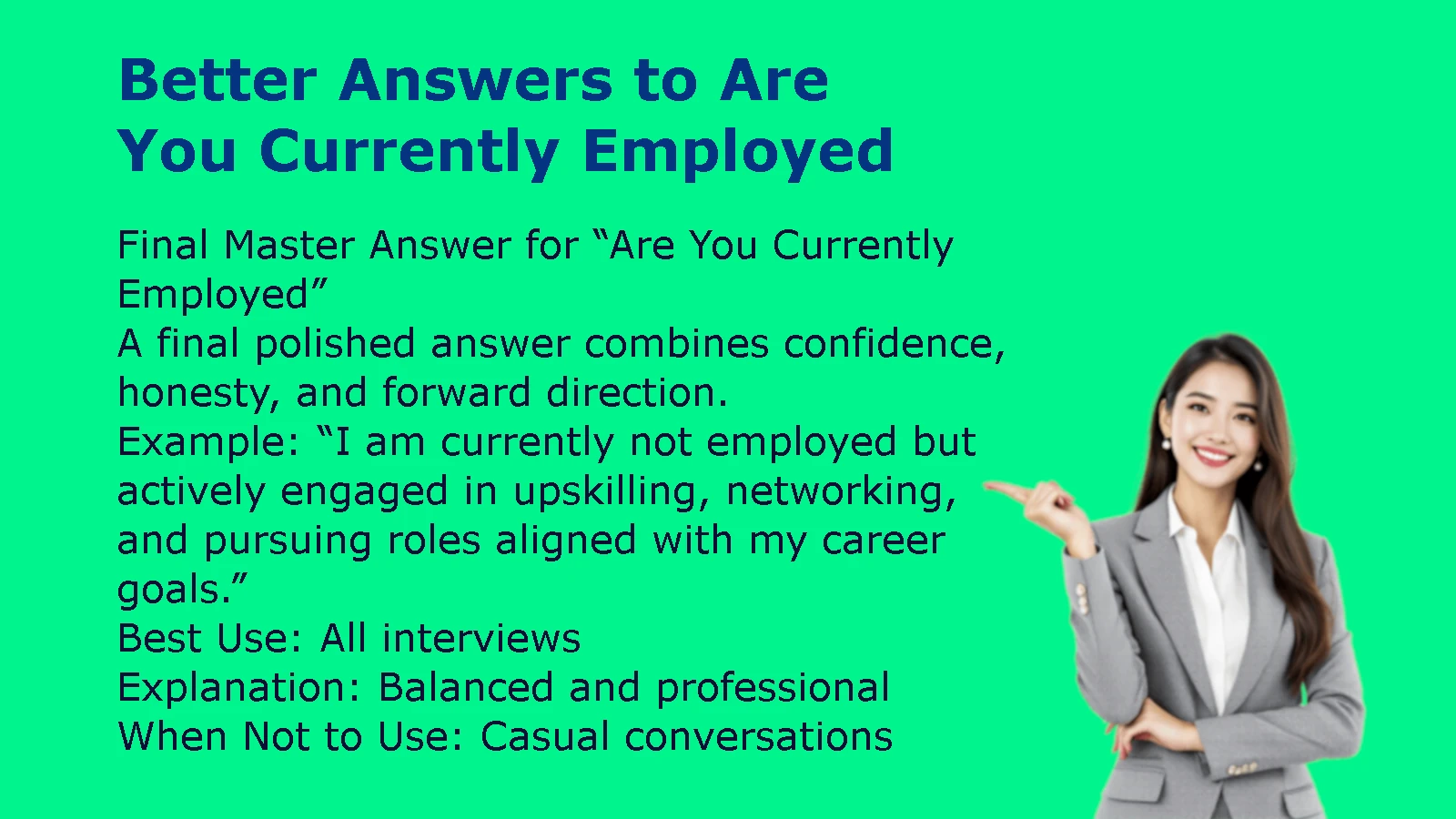
47. Final Master Answer for “Are You Currently Employed”
A final polished answer combines confidence, honesty, and forward direction.
Example: “I am currently not employed but actively engaged in upskilling, networking, and pursuing roles aligned with my career goals.”
Best Use: All interviews
Explanation: Balanced and professional
When Not to Use: Casual conversations
FAQs
What is the safest answer to “Are you currently employed?”
A safe answer is a simple honest statement combined with a positive career direction.
How do I explain a long job gap?
Focus on learning, personal development, or responsibilities during that time.
Can freelancing replace full-time employment in answers?
Yes, freelancing is a valid professional status in interviews.
Should I mention layoffs in interviews?
Yes, but briefly and neutrally without emotional detail.
What makes a strong employment status answer?
Clarity, honesty, positivity, and a focus on future goals.
Conclusion
Mastering all 47 better answers to “Are you currently employed” gives you a powerful advantage in interviews, networking, and professional communication. The key lesson is simple: never focus only on employment status—focus on growth, direction, and value creation. When you communicate with clarity and confidence, even gaps and transitions become strong storytelling assets that improve your credibility and hiring chances.