Have you ever been in a situation where someone says “I’m fine”, but their tone, expression, or energy clearly suggests otherwise? Knowing the Best Responses When Someone Says They’re Fine can make a huge difference in how you communicate, build trust, and support others in emotional or everyday conversations. This phrase is one of the most common yet misunderstood signals in human interaction, often used to hide feelings, avoid discussion, or politely end a conversation.
In simple terms, when someone says they’re “fine,” it doesn’t always mean they truly are. It can indicate stress, sadness, discomfort, or hesitation to open up, depending on the context. That’s why understanding the right response is important in friendship, relationships, workplace communication, and even casual chats. The way you reply can either encourage honesty or unintentionally shut the conversation down.
This topic connects closely with emotional intelligence, communication skills, empathy in conversation, and psychological awareness, making it especially useful in both personal and professional life. Many people search for natural, kind, and appropriate replies that don’t feel forced or awkward but still show genuine care and attention.
In this guide, you’ll learn practical, thoughtful, and context-based responses you can use when someone says they’re fine, along with examples that help you choose the right words in different situations—whether you’re talking to a friend, family member, coworker, or partner.
1. “Are you sure? I’m here if you need me.”
Sometimes people say “I’m fine” just to avoid explaining their emotions. In real life, a close friend might say this after a stressful day at work. You notice their tone feels off. Instead of pushing them, this gentle response shows care without pressure, giving them space while still letting them know they are supported and not alone in their situation.
Example: Are you sure? I’m here if you need me.
Best use: When someone seems emotionally distant
Explanation: Shows support without forcing conversation
When not to use: With strangers or formal settings
2. “You don’t sound fine—want to talk?”
Story:
People often hide emotions behind short replies. A colleague may say “I’m fine” during lunch but avoid eye contact. You sense something is wrong. This response gently opens the door for conversation without judgment, encouraging honesty while respecting their emotional boundary.
Example: You don’t sound fine—want to talk?
Best use: Friends or coworkers
Explanation: Encourages openness
When not to use: When privacy is needed
3. “Okay, but I’m here if that changes.”
Story:
Not everyone is ready to open up immediately. A family member might shut down after an argument. Instead of pushing, this response gives them time while keeping emotional availability clear. It builds trust over time.
Example: Okay, but I’m here if that changes.
Best use: Family situations
Explanation: Respects emotional timing
When not to use: Emergency situations
4. “I understand, but I care about how you feel.”
Story:
Someone might say “I’m fine” when they actually feel overwhelmed. You may notice their behavior is different. This response balances understanding with care, showing emotional awareness without being invasive.
Example: I understand, but I care about how you feel.
Best use: Close relationships
Explanation: Shows empathy
When not to use: Casual strangers
5. “Want some space or support?”
Story:
People sometimes need different things when upset. A friend might not know how to respond to stress. Offering a choice helps them feel in control instead of pressured.
Example: Want some space or support?
Best use: Emotional situations
Explanation: Gives autonomy
When not to use: Formal communication
6. “I’m not convinced, but I won’t push you.”
Story:
When someone is clearly hiding emotions, you may feel unsure how to react. This response gently acknowledges your observation while respecting their silence.
Example: I’m not convinced, but I won’t push you.
Best use: Close friends
Explanation: Honest but respectful
When not to use: Professional tone required
7. “If something’s wrong, I’d rather know.”
Story:
Sometimes silence makes situations worse. A partner might withdraw emotionally. This response opens honesty while showing emotional investment.
Example: If something’s wrong, I’d rather know.
Best use: Relationships
Explanation: Encourages transparency
When not to use: Early friendships
8. “Take your time, I’m listening.”
Story:
A person may need time before speaking. This response removes pressure and builds comfort, especially in emotional moments.
Example: Take your time, I’m listening.
Best use: Emotional conversations
Explanation: Builds trust
When not to use: Fast-paced situations
9. “You can tell me when you’re ready.”
Story:
Some people need emotional safety before opening up. This line reassures them that timing is under their control.
Example: You can tell me when you’re ready.
Best use: Sensitive topics
Explanation: Reduces pressure
When not to use: Urgent matters
10. “I care about you, even if you’re quiet.”
Story:
Silence doesn’t always mean peace. A loved one may withdraw. This response shows unconditional support.
Example: I care about you, even if you’re quiet.
Best use: Close bonds
Explanation: Emotional reassurance
When not to use: Formal settings
11. “Do you want to distract yourself or talk?”
Story:
Sometimes people prefer distraction over discussion. Offering options helps them feel understood.
Example: Do you want to distract yourself or talk?
Best use: Stress situations
Explanation: Provides choice
When not to use: Serious crises
12. “I’m noticing something feels off.”
Story:
When behavior changes, acknowledging it gently can open conversation without accusation.
Example: I’m noticing something feels off.
Best use: Friends or partners
Explanation: Observational empathy
When not to use: Strangers
13. “You don’t have to pretend with me.”
Story:
People often hide emotions to appear strong. This response creates emotional safety.
Example: You don’t have to pretend with me.
Best use: Close relationships
Explanation: Encourages honesty
When not to use: Workplace formal talk
14. “I’m here whether you talk or not.”
Story:
Support isn’t always verbal. This line shows presence matters more than conversation.
Example: I’m here whether you talk or not.
Best use: Emotional support
Explanation: Reassurance
When not to use: Quick interactions
15. “You seem like something’s bothering you.”
Story:
Body language often reveals emotions. This response gently reflects observation.
Example: You seem like something’s bothering you.
Best use: Friends
Explanation: Encourages sharing
When not to use: Formal settings
16. “I won’t judge you, whatever it is.”
Story:
Fear of judgment often stops people from opening up.
Example: I won’t judge you, whatever it is.
Best use: Deep conversations
Explanation: Builds trust
When not to use: Professional environments
17. “That ‘fine’ doesn’t sound convincing.”
Story:
Sometimes tone reveals more than words. This helps gently point it out.
Example: That ‘fine’ doesn’t sound convincing.
Best use: Close friends
Explanation: Emotional awareness
When not to use: Sensitive strangers
18. “I can wait until you’re ready.”
Story:
Patience is powerful in emotional conversations.
Example: I can wait until you’re ready.
Best use: Emotional support
Explanation: Shows patience
When not to use: Urgent help needed
19. “You matter more than ‘fine.’”
Story:
This helps shift focus from surface answers to real emotions.
Example: You matter more than ‘fine.’
Best use: Close relationships
Explanation: Emotional validation
When not to use: Casual talk
20. “Want me to sit with you?”
Story:
Presence alone can be comforting during emotional moments.
Example: Want me to sit with you?
Best use: Comfort situations
Explanation: Non-verbal support
When not to use: Busy environments
21. “You don’t have to handle it alone.”
Story:
Many people isolate themselves during stress.
Example: You don’t have to handle it alone.
Best use: Supportive relationships
Explanation: Encouragement
When not to use: Independence-focused situations
22. “I’m not going anywhere.”
Story:
Consistency builds emotional safety in relationships.
Example: I’m not going anywhere.
Best use: Close bonds
Explanation: Reassurance
When not to use: New acquaintances
23. “I’m here when words are hard.”
Story:
Sometimes emotions are too heavy to express verbally.
Example: I’m here when words are hard.
Best use: Emotional breakdowns
Explanation: Silent support
When not to use: Casual talk
24. “Even silence tells me something.”
Story:
Silence can be powerful communication in itself.
Example: Even silence tells me something.
Best use: Emotional awareness
Explanation: Acknowledges non-verbal cues
When not to use: Formal settings
25. “I just want you okay, not ‘fine.’”
Story:
This response shifts focus from surface-level answers to true wellbeing.
Example: I just want you okay, not ‘fine.’
Best use: Deep relationships
Explanation: Emotional honesty
When not to use: Professional context
26. “I feel like there’s more you’re not saying.”
Sometimes people use “I’m fine” as a shield to avoid deeper emotional conversations. You may notice a friend going quiet after a stressful event. Instead of assuming, this response gently reflects what you observe. It encourages honesty without pressure and shows emotional awareness in a calm, non-judgmental way that keeps the conversation open and safe.
Example: I feel like there’s more you’re not saying.
Best use: Close friends or partners
Explanation: Encourages honesty through observation
When not to use: Professional settings
27. “I’m here if you want to let it out.”
People often suppress emotions until they feel safe enough to express them. A colleague or friend might act normal but seem distant. This response creates a soft emotional opening. It reassures them that expressing feelings is welcome and that you are available without forcing them into conversation before they are ready.
Example: I’m here if you want to let it out.
Best use: Emotional support moments
Explanation: Encourages emotional release
When not to use: Formal or workplace hierarchy situations
28. “You don’t have to carry this alone.”
Stress often makes people isolate themselves emotionally. Even loved ones may withdraw and insist they are “fine.” This response reminds them that support exists. It reduces emotional burden by showing shared presence and care, making it easier for them to open up when they feel ready.
Example: You don’t have to carry this alone.
Best use: Supportive relationships
Explanation: Reduces emotional isolation
When not to use: Casual acquaintances
29. “It’s okay not to be okay.”
Many people hide emotions because they feel pressure to appear strong. When someone says “I’m fine,” it may actually mean they are struggling. This response normalizes vulnerability and reassures them that emotions are valid. It creates emotional permission to be honest without fear of judgment.
Example: It’s okay not to be okay.
Best use: Emotional reassurance
Explanation: Normalizes vulnerability
When not to use: Strict professional environments
30. “I’m not here to fix it, just to listen.”
Sometimes people don’t want solutions—they just want to be heard. A friend might say “I’m fine” to avoid long explanations. This response removes pressure and clarifies your supportive role. It builds trust by showing that emotional safety matters more than problem-solving.
Example: I’m not here to fix it, just to listen.
Best use: Emotional conversations
Explanation: Reduces pressure
When not to use: Emergency situations
31. “If I were in your place, I might feel the same.”
Empathy helps people feel understood rather than judged. When someone hides emotions, this response shows emotional alignment. It helps them feel less alone in their experience and encourages openness by validating their possible feelings without forcing them to explain everything immediately.
Example: If I were in your place, I might feel the same.
Best use: Close relationships
Explanation: Builds empathy
When not to use: Formal discussions
32. “You seem like you’re holding something back.”
Sometimes body language reveals more than words. A friend may smile but avoid eye contact. This response gently reflects your observation without accusation. It helps them recognize their own emotional state and gives them space to choose whether to open up.
Example: You seem like you’re holding something back.
Best use: Friends or partners
Explanation: Encourages self-reflection
When not to use: Workplace settings
33. “I care about what you’re not saying too.”
Silence often carries meaning. Someone may repeatedly say “I’m fine” while acting distant. This response acknowledges unspoken emotions. It reassures them that you are paying attention beyond words, which can build deeper emotional trust over time.
Example: I care about what you’re not saying too.
Best use: Close emotional bonds
Explanation: Acknowledges hidden feelings
When not to use: Casual interactions
34. “Take your time, I’m right here.”
People often need emotional space before they feel ready to talk. A friend may withdraw after stress or conflict. This response gives them time while maintaining your presence. It removes urgency and builds emotional safety, making future communication easier.
Example: Take your time, I’m right here.
Best use: Emotional support situations
Explanation: Encourages patience
When not to use: Time-sensitive issues
35. “You don’t have to explain everything right now.”
When emotions are overwhelming, explaining feelings can feel exhausting. Someone saying “I’m fine” may actually be avoiding pressure. This response removes expectation and allows gradual sharing. It helps reduce anxiety around emotional conversations.
Example: You don’t have to explain everything right now.
Best use: Sensitive discussions
Explanation: Reduces pressure
When not to use: Urgent problem-solving
36. “I can stay with you in silence too.”
Not all support requires conversation. Sometimes just being present is enough. A friend may not want to talk but still need company. This response shows emotional maturity by offering comfort without forcing dialogue.
Example: I can stay with you in silence too.
Best use: Emotional comfort
Explanation: Supports silent presence
When not to use: Fast-moving environments
37. “Your silence tells me something matters.”
When someone becomes quiet, it often signals emotional weight. Instead of ignoring it, this response gently acknowledges it. It helps the person feel seen without pressure, encouraging them to share only if they choose.
Example: Your silence tells me something matters.
Best use: Close relationships
Explanation: Recognizes emotional signals
When not to use: Formal contexts
38. “I’m here no matter how you feel.”
Emotional consistency is important in relationships. When someone says “I’m fine,” they may fear being a burden. This response reassures them that their emotional state does not change your support or presence.
Example: I’m here no matter how you feel.
Best use: Deep relationships
Explanation: Provides reassurance
When not to use: Professional interactions
39. “You don’t have to pretend around me.”
People often hide emotions to appear strong. A friend might smile while struggling inside. This response helps remove emotional masks and creates a safe space for authenticity.
Example: You don’t have to pretend around me.
Best use: Trusted relationships
Explanation: Encourages authenticity
When not to use: Workplace communication
40. “I’m not going to ignore how you feel.”
Sometimes people dismiss their own emotions. When someone says “I’m fine,” they might be minimizing their feelings. This response validates emotional presence and shows attentiveness.
Example: I’m not going to ignore how you feel.
Best use: Emotional support
Explanation: Validates feelings
When not to use: Casual conversations
41. “Even if you don’t talk, I still care.”
Silence can sometimes feel isolating. A person may withdraw emotionally but still need support. This response reassures them that care is not dependent on communication.
Example: Even if you don’t talk, I still care.
Best use: Emotional reassurance
Explanation: Unconditional support
When not to use: Formal settings
42. “I can tell something is weighing on you.”
Stress often shows through behavior changes. Instead of ignoring it, this response gently acknowledges emotional heaviness. It opens a safe path for conversation without pressure.
Example: I can tell something is weighing on you.
Best use: Friends or partners
Explanation: Observational empathy
When not to use: Professional environments
43. “You matter more than pretending you’re fine.”
People often hide struggles to avoid attention. This response helps shift focus from appearance to emotional truth. It reinforces that honesty is more important than pretending.
Example: You matter more than pretending you’re fine.
Best use: Close relationships
Explanation: Encourages honesty
When not to use: Work settings
44. “I don’t need perfect words, just honesty.”
Many people struggle to express emotions clearly. This response reduces pressure by valuing honesty over perfection, making it easier for them to open up.
Example: I don’t need perfect words, just honesty.
Best use: Emotional conversations
Explanation: Encourages openness
When not to use: Formal communication
45. “You can trust me with the real answer.”
Trust builds slowly in relationships. Someone saying “I’m fine” might not feel safe enough to open up. This response gently encourages honesty by reinforcing trust and safety.
Example: You can trust me with the real answer.
Best use: Close bonds
Explanation: Builds trust
When not to use: Early interactions
46. “I’m here whether it’s good or bad.”
People often fear being judged for negative emotions. This response assures them that your presence is not dependent on their emotional state, strengthening emotional stability in relationships.
Example: I’m here whether it’s good or bad.
Best use: Emotional support
Explanation: Provides stability
When not to use: Professional environments
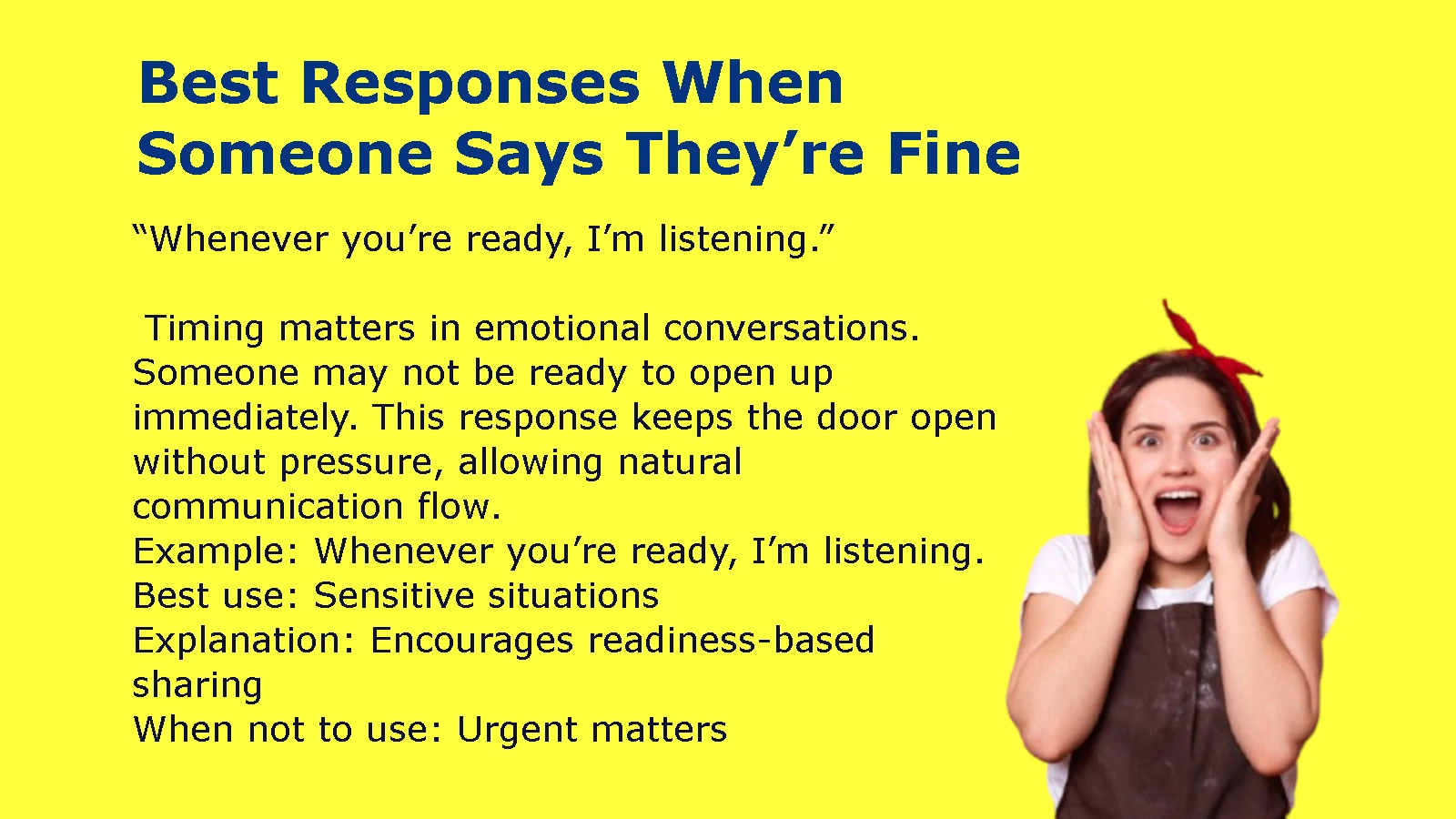
47. “Whenever you’re ready, I’m listening.”
Timing matters in emotional conversations. Someone may not be ready to open up immediately. This response keeps the door open without pressure, allowing natural communication flow.
Example: Whenever you’re ready, I’m listening.
Best use: Sensitive situations
Explanation: Encourages readiness-based sharing
When not to use: Urgent matters
Final Conclusion
These 47 best responses when someone says they’re fine help you handle one of the most common emotional communication challenges with care and intelligence. The key is not to force answers but to create a safe emotional space where honesty feels natural. Using these responses wisely can strengthen trust, deepen relationships, and improve emotional understanding in everyday life.